
At a certain scale, the screw compressor stops making sense. Not because it is a bad machine—it is an excellent one. But physics imposes limits. When your plant needs 5,000 CFM or more of compressed air, the economics tilt decisively toward centrifugal compression.
This article explains why. We compare centrifugal and screw compressors across six dimensions: working principle, capacity range, energy efficiency, maintenance profile, footprint, and industry fit. If you are specifying a large-scale compressed air system, this is your decision framework.
1. How They Work: Two Fundamentally Different Approaches
Understanding the physics is essential to understanding the economics.
Screw Compressors: Positive Displacement
A screw compressor traps air between two intermeshing rotors and reduces the volume of that trapped pocket as it moves axially. This is positive displacement: regardless of discharge pressure (within design limits), the machine moves a fixed volume of air per revolution.
The result is excellent part-load efficiency and the ability to maintain stable pressure across a wide operating range. This is why screw compressors dominate the 15-500 HP segment.
Centrifugal Compressors: Dynamic Compression
A centrifugal compressor accelerates air through a high-speed impeller and then decelerates it in a diffuser, converting velocity into pressure. This is dynamic compression: the machine imparts kinetic energy to the air, then recovers it as potential energy (pressure).
The result is extremely high flow capacity from a compact machine, with no metal-to-metal contact in the compression path. This is why centrifugal compressors own the 500 HP+ segment in process industries.
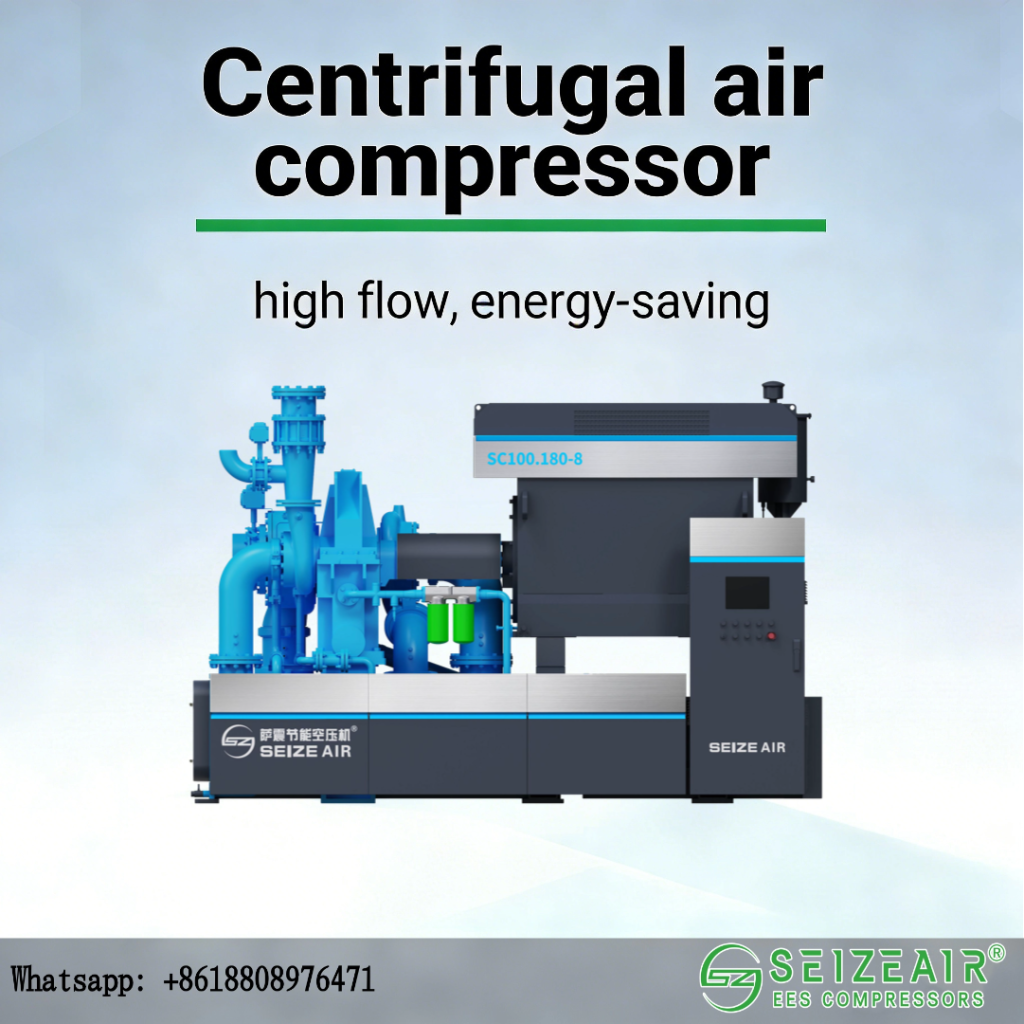
SEIZE AIR centrifugal compressor — purpose-built for high-flow, continuous-duty industrial applications.
Close-up of a centrifugal impeller — the heart of dynamic compression.
2. Capacity Range: Where Each Technology Belongs
This is the single most important comparison table you will read today.
| Parameter | Screw Compressor | Centrifugal Compressor |
|---|---|---|
| Typical capacity range | 30-5,000 CFM | 1,000-50,000+ CFM |
| Sweet spot | 100-2,000 CFM | 5,000-25,000 CFM |
| Pressure range | 100-215 PSI (single-stage) | 100-500+ PSI (multi-stage) |
| Maximum single-unit capacity | ~5,000 CFM | 50,000+ CFM |
| Turndown capability | 20-100% (VSD models) | 70-100% (IGV modulated) |
| Best part-load efficiency | Excellent (VSD) | Good (IGV + blow-off) |
| Best full-load efficiency | Good | Excellent |
The pattern is clear: below 2,000 CFM, screw compressors are competitive. Above 5,000 CFM, centrifugal is the default choice. The 2,000-5,000 CFM range is the battleground—and where a detailed TCO analysis matters most.
3. Energy Efficiency: The Real Decision Driver
Energy accounts for 70-80% of a compressor’s lifecycle cost. Here is how the two technologies compare at scale.
Full-Load Efficiency
At full load, a well-designed centrifugal compressor achieves isentropic efficiencies of 82-87%, compared to 75-82% for a single-stage oil-injected screw. The gap widens at larger capacities because centrifugal stages can be optimized for specific flow coefficients.
For a 10,000 CFM system running 8,000 hours per year, a 5-percentage-point efficiency difference translates to approximately $80,000-$120,000 in annual electricity savings (at $0.10/kWh). Over a 15-year service life, that is $1.2-1.8 million.
Part-Load Efficiency
Screw compressors with variable-speed drives (VSD) maintain high efficiency down to 20-30% load. Centrifugals use inlet guide vanes (IGVs) and typically maintain reasonable efficiency down to 60-70% before requiring blow-off, which wastes energy.
The implication: In plants with highly variable demand, a combination of centrifugal base-load machines and VSD screw trim units often yields the lowest overall energy cost.
4. Maintenance Profile: Hours, Complexity, and Skill Requirements
| Maintenance Item | Screw Compressor | Centrifugal Compressor |
|---|---|---|
| Airend/compressor element life | 40,000-80,000 hours | 100,000+ hours (no contact wear) |
| Oil changes | Every 2,000-8,000 hours | Lube oil system: every 8,000-16,000 hours |
| Bearings | Rolling element, replace at 40,000h | Tilt-pad journal + thrust; replace at 50,000-80,000h |
| Seals | Shaft seal, replace as needed | Labyrinth/dry gas seals; minimal wear |
| Major overhaul interval | 5-8 years | 8-12 years |
| Technician skill required | General industrial mechanic | Specialized turbomachinery technician |
| Annual maintenance cost (% of capital) | 3-5% | 2-4% |
Key insight: Centrifugals have longer intervals between major interventions, but when work is needed, it requires specialized skills. Plan your service contracts accordingly.
5. Footprint and Installation: Space Matters
A 5,000 CFM screw compressor installation might require 3-4 parallel units plus dryers, filters, and receivers—easily filling a 500-800 sq ft equipment room.
A single 5,000 CFM centrifugal compressor with integrated intercoolers and controls occupies roughly 40-60% of the floor space of the equivalent multi-screw installation. This is a decisive advantage in brownfield plants where real estate is at a premium.
Installation Complexity
| Factor | Screw (Multi-Unit) | Centrifugal (Single Unit) |
|---|---|---|
| Foundation requirements | Standard pad | Engineered foundation (dynamic loads) |
| Piping complexity | High (multiple units, manifolds) | Low (single inlet/outlet) |
| Electrical | Multiple smaller starters | Single large MV starter |
| Cooling water | Multiple smaller circuits | Single large circuit |
| Commissioning time | 2-4 weeks | 4-8 weeks |
6. Industry Fit: Where Each Technology Dominates
Industries Where Centrifugal is the Standard
| Industry | Typical Capacity | Why Centrifugal |
|---|---|---|
| Air separation (ASU) | 20,000-200,000 CFM | Massive flow, continuous 24/7 operation |
| LNG liquefaction | 50,000-500,000 CFM | Extreme scale, process integration |
| Petrochemical / refining | 5,000-50,000 CFM | Reliability, oil-free air requirement |
| Steel manufacturing | 10,000-40,000 CFM | Blast furnace air, continuous duty |
| Large-scale electronics | 3,000-15,000 CFM | Oil-free, stable pressure |
| Power generation | 5,000-20,000 CFM | Instrument air, soot blowing |
Industries Where Screw Compressors Excel
| Industry | Typical Capacity | Why Screw |
|---|---|---|
| General manufacturing | 100-2,000 CFM | Right-sized, flexible, low capital cost |
| Automotive assembly | 500-5,000 CFM | Variable demand, VSD efficiency |
| Food & beverage | 200-3,000 CFM | Modular redundancy, oil-free options |
| Pharmaceuticals | 200-2,000 CFM | Validated oil-free, multi-unit redundancy |
| Textiles | 500-3,000 CFM | Moderate flow, cost-sensitive |
7. The Decision Framework
Ask these five questions. If you answer “yes” to three or more, centrifugal is likely your answer.
- Is your total plant demand above 5,000 CFM? → Centrifugal’s efficiency advantage becomes material.
- Do you run 24/7 with a base load above 70% of capacity? → Centrifugal excels at steady-state operation.
- Is floor space constrained? → One centrifugal replaces multiple screws.
- Do you require 100% oil-free air (ISO Class 0)? → Centrifugal is inherently oil-free in the compression path.
- Is your planning horizon 10+ years? → Centrifugal’s longer service life and lower lifecycle cost justify the higher upfront capital.
8. The Hybrid Approach: Best of Both Worlds
Many large plants run a hybrid system:
- 1-3 centrifugal compressors for base load (60-80% of total demand)
- 1-2 VSD screw compressors for trim and peak shaving
- A master controller that sequences units for optimal efficiency
This configuration delivers the best blended efficiency across all load conditions. SEIZE AIR offers both technologies and can design an integrated system with unified controls.
Explore SEIZE AIR’s centrifugal compressor portfolio
9. Frequently Asked Questions
Q: What is the minimum capacity for a centrifugal compressor to be economical?
A: Generally 1,000-2,000 CFM. Below this, screw compressors have lower capital cost and competitive efficiency.
Q: Can centrifugal compressors handle variable demand?
A: Yes, via inlet guide vanes (IGVs) and variable-speed drives on smaller models. However, turndown below 60-70% requires blow-off, which wastes energy. Pair with a VSD screw for best part-load performance.
Q: Are centrifugal compressors oil-free?
A: The compression path is inherently oil-free (no oil in the air stream). The lube oil system is sealed and separate, lubricating bearings and gears only. This achieves ISO 8573-1 Class 0 certification.
Q: How long does a centrifugal compressor last?
A: With proper maintenance, 25-30+ years. The impellers and diaphragms have no contact wear mechanisms. Bearings and seals are the primary wear items.
Q: What are the lead times for a centrifugal compressor?
A: Typically 8-14 months for a custom-engineered unit. SEIZE AIR maintains an expedited program for standard configurations at 6-8 months.
Conclusion
The screw compressor is the workhorse of general industry. The centrifugal compressor is the thoroughbred of large-scale process applications.
If your plant is crossing the 5,000 CFM threshold—or planning to—it is time to evaluate centrifugal seriously. The efficiency gains alone can fund the capital premium within 2-3 years.
Contact SEIZE AIR’s centrifugal engineering team for a site-specific feasibility analysis, including energy benchmarking against your current system and a detailed TCO projection.