
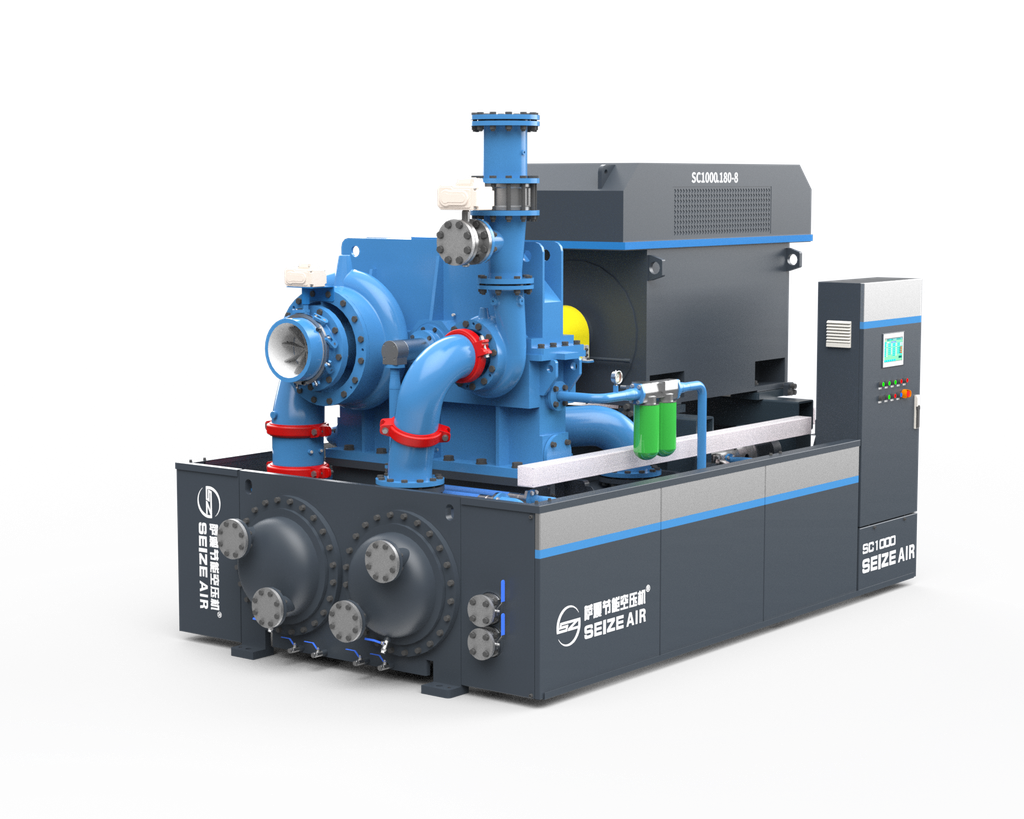
A centrifugal air compressor is a dynamic, oil-free machine built to deliver very large volumes of clean compressed air at stable pressure for continuous, 24/7 industrial duty. When your plant needs tens of thousands of cubic meters per hour of oil-free air, running around the clock with minimal maintenance and almost no wearing parts, a centrifugal air compressor is usually the answer.
This complete guide explains how a centrifugal air compressor works, its main types, where it earns its keep across oil & gas, petrochemical, power, LNG and marine service, and — most importantly — how to select one against your real duty parameters rather than a brochure number.
Consider the moment a utilities engineer at a coastal refinery realizes the eight aging screw machines on the instrument-air header are swallowing oil filters and still sagging on pressure during a summer demand peak. The fix is rarely “buy a bigger screw.” It is usually a single oil-free centrifugal air compressor sized to the steady base load, with the screws left to trim the peaks.
You already agree plant air is the “fourth utility” — invisible until it fails. You promise this guide gives you the engineering reasoning to choose centrifugal technology with confidence, not vendor slogans. We cover the working principle, machine types, heavy-industry applications, a practical selection method, life-cycle cost logic, and the maintenance realities — including surge, the one failure mode unique to dynamic compression. For a shorter primer aimed at new team members, our blog also covers the fundamentals.
Key Takeaways
- A centrifugal air compressor uses dynamic (not positive-displacement) compression: a high-speed impeller converts kinetic energy into pressure, ideal for very large, steady, oil-free airflow.
- Oil-free operation is inherent — no oil sits in the compression path — and units are routinely specified to ISO 8573-1 Class 0 for total oil.
- The technology dominates continuous-duty, high-flow applications in oil & gas, petrochemical, power, LNG, marine and air-separation plants.
- Selection is a method, not a model number: define duty parameters, cooling and footprint, turndown and surge margin, then air-quality class.
- Surge is the defining risk; API 617 governs compressor design and anti-surge control philosophy for process service.
What Is a Centrifugal Air Compressor?
A centrifugal air compressor is a turbo machine that raises air pressure by spinning it at very high speed rather than squeezing it in a trapped volume.
The cleanest way to grasp it is by contrast with the other two families:
- Positive-displacement (screw, piston): trap a pocket of air, shrink it, and force pressure up. Flow is largely independent of discharge pressure until a mechanical limit.
- Dynamic / centrifugal: add velocity with a spinning impeller, then let a stationary diffuser convert that velocity into pressure. Output depends on the square of tip speed, and flow is tightly coupled to pressure — which is why centrifugal machines love steady, high-volume duty and dislike being throttled hard.
Because no meshing rotor or piston drags through a lubricated chamber, an oil-free centrifugal air compressor keeps lubrication in a separate gearbox and bearings, fully out of the air stream. That single fact makes it the default where oil contamination is unacceptable.
“Centrifugal” does not mean “huge” — size follows duty, not definition. What defines a centrifugal air compressor is the compression physics: dynamic, continuous, oil-free-by-design, and most efficient near its design point over long runs.
How Does a Centrifugal Air Compressor Work?
The core idea never changes: spin air fast, then slow it in a controlled space so speed becomes pressure. Here is the path through a typical oil-free centrifugal air compressor.
- Inlet and inlet guide vanes (IGV). Ambient air passes a filter and silencer, then adjustable IGVs that pre-swirl the air and act as the primary capacity-control device — modulating them matches part-load demand without blow-off.
- Impeller acceleration. Air enters the eye of a high-speed impeller, often tens of thousands of RPM. Centrifugal force flings it outward, raising velocity dramatically — where most work is done.
- Diffuser. The fast air enters a stationary vaned or vaneless diffuser; as the flow area expands, velocity drops and kinetic energy converts into static pressure.
- Volute (scroll casing). A spiral collector gathers the pressurized air and routes it to the next stage or discharge.
- Intercooling. Between stages, a cooler shrinks the volume and cuts the work for the next step — why multi-stage machines are far more efficient at higher pressures.
- Multi-stage repetition. Steps 2–5 repeat across two, three, or more impellers on a common shaft until target discharge pressure is reached.
Types of Centrifugal Air Compressors
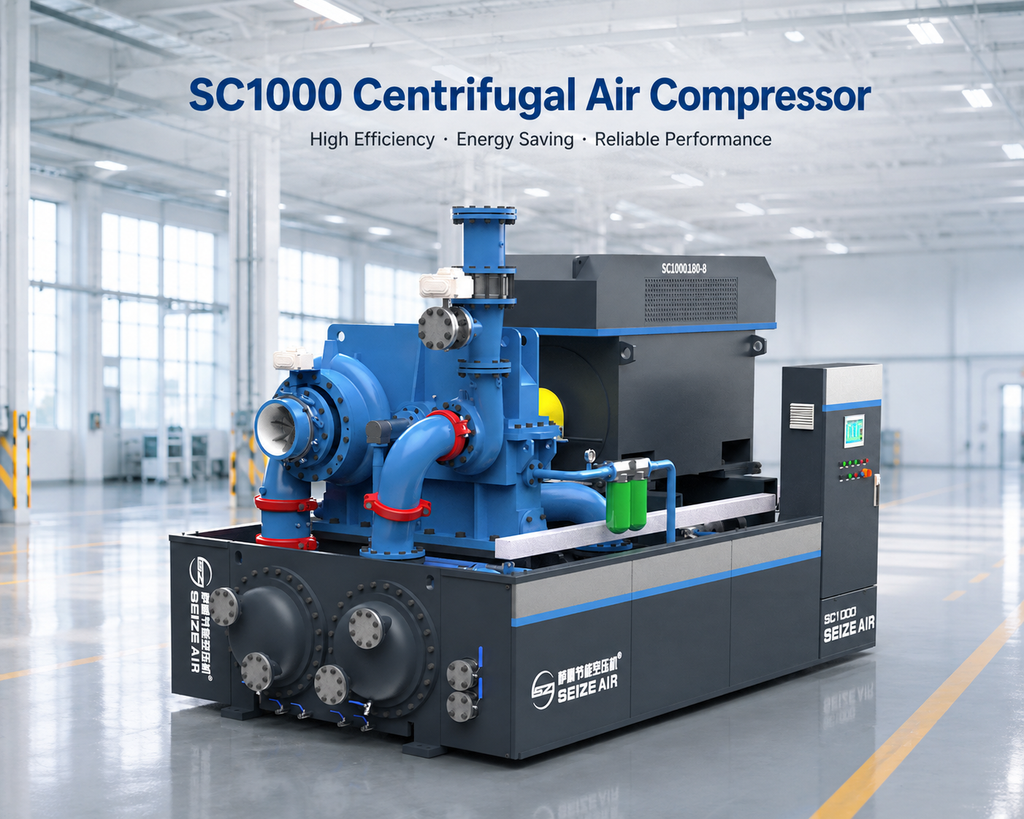
The categories below rarely appear alone — a real machine combines them — but they frame the choices that matter.
Oil-Free vs Oil-Injected
For plant and instrument air in process industries, oil-free is the standard. In an oil-free centrifugal air compressor the compression path contains no oil; lubrication lives only in the gearbox and bearings, sealed from the air, which is what lets the machine meet the strictest purity expectations. “Oil-injected” centrifugal designs are uncommon for air service and more typical of specialized process-gas duties — for this guide’s applications, oil-free is the right lane.
On purity: a properly designed oil-free centrifugal machine can deliver ISO 8573-1 Class 0 air for total oil. Be precise — Class 0 is not literal “zero oil” and not a single fixed number; it is a specification agreed between user and supplier, stricter than Class 1 (≤0.01 mg/m³ total oil), and a genuine claim must name the contaminant and agreed limit in writing. We do not assert a specific class level for any SEIZE AIR unit here; confirm the agreed specification with the factory.
Integrally Geared vs Direct-Drive High-Speed Turbo
- Integrally geared: one gearbox drives multiple impellers at different speeds, each optimized for its stage — the classic architecture for large multi-stage packages: compact, efficient, proven in continuous duty.
- Direct-drive high-speed turbo: a high-speed motor (often magnetic or air bearings with a VSD) spins the impeller directly, eliminating the gearbox — the emerging architecture for certain mid-flow, oil-free, low-maintenance packages.
Both are legitimate. Geared favors maximum flow and field heritage; direct-drive turbo favors simplicity and minimal lubrication. The choice follows flow, speed, footprint, and service philosophy.
Radial vs Axial
- Radial (centrifugal): flow enters axially at the impeller eye and exits radially — the machine throughout this guide, handling large flows and moderate-to-high pressures of industrial plant air.
- Axial: flow moves parallel to the shaft through blade rows. Axial machines dominate aviation and very large turbine drivers, rarely the right tool for industrial compressed-air plants.
For oil & gas, petrochemical, power, LNG and marine air, you are selecting a radial centrifugal air compressor.
Advantages & Limitations
Advantages
- Very large flow from one machine — serves base loads needing many parallel screw or piston units.
- Inherently oil-free air — no oil in the path, no carryover, no coalescing-filter oil burden.
- Few wearing parts — no reciprocating or meshing contact in the air path; long hours between major services.
- Stable, pulse-free discharge — dynamic compression delivers steady pressure and flow.
- Low air-end maintenance — the rotating group is robust inside its map.
Limitations
- Narrow stable range — efficiency and stability fall off away from the design point; too little flow approaches surge.
- Surge risk at low flow — the defining failure mode of dynamic compression (covered in Maintenance).
- Higher capital cost and longer lead time than small screw or piston units, justified by duty rather than low-flow comparison.
- Less flexible at deep turndown than a VSD screw without proper capacity control.
| Dimension | Centrifugal | Screw | Piston |
| Best flow regime | Very large, steady | Medium, variable | Small, intermittent |
| Oil-free by design | Yes (air path) | Only oil-free variants | Only special oil-free |
| Wearing parts in air path | Minimal | Rotors/seals | Rings, valves |
| Turndown flexibility | Narrower | Wide (with VSD) | Wide |
| Typical duty | 24/7 base load | Base + variable | Batch/intermittent |
For the deeper technology comparison with part-load behavior, our related analysis on the blog walks through centrifugal vs screw vs piston in detail.
Industrial Applications
This is where the centrifugal air compressor justifies its reputation: large, continuous, oil-free air demand in environments that cannot tolerate downtime.
Oil & Gas / Pipeline
Upstream, midstream, and pipeline operators need dependable instrument air, utility plant air, and feed air for on-site nitrogen generation used in blanketing and purging. At remote gathering stations and pipeline sites, a single oil-free centrifugal air compressor serves the steady utility-air base load with minimal attendance — high running hours, few wearing parts, and no oil reaching sensitive valves and analyzers.
Petrochemical & Refining
Refineries and petrochemical complexes run continuously, and air-system contamination can trigger product-quality incidents. Centrifugal machines supply instrument air, general plant air, and large feed-air volumes for on-site air separation (nitrogen for inerting, oxygen for process). Oil-free delivery protects catalysts, products, and instruments.
Power Generation
Power stations use compressed air for instrument and control systems, ash handling, pneumatic conveying, flue-gas treatment, and often as feed for on-site oxygen or hydrogen. A large base-load utility-air demand suits a centrifugal machine sized to the continuous load, with smaller units or receivers covering transients. Low maintenance matches the plant’s must-run mentality.
LNG
LNG liquefaction and regasification terminals are air-hungry. Large air separation units produce nitrogen for tank inerting, purging, and the liquefaction train, fed by massive steady air streams — the centrifugal compressor’s home turf. Plant and instrument air plus nitrogen-generation feed add to the duty; the 24/7, high-flow, oil-free profile fits exactly.
Marine / Shipboard
On vessels and offshore platforms, compressed air starts large main and auxiliary diesel engines, powers control and utility systems, and feeds inert-gas and nitrogen systems. Space and weight are tight, attendance limited, reliability non-negotiable. Picture the sizing on an LNG carrier: the engineer pairs a centrifugal base-load machine with receivers sized to the start sequence, cutting the lubrication and filter burden of several smaller units.
Air Separation (ASU) & Process Gas
Air separation is the purest expression of the technology: a main air compressor feeds the distillation column with enormous, steady airflow, often with a booster and expander. Beyond air, the same dynamic principle compresses process gases — nitrogen, oxygen, carbon dioxide, treated hydrocarbons — in petrochemical and gas processing. This guide focuses on air, but the selection logic transfers directly.
How to Select a Centrifugal Air Compressor
Selecting a centrifugal air compressor is a method. Resist starting from a model number; work the steps and the right machine definition emerges.
Duty Parameters
Start with the physics of your demand:
- Flow — volume required, in m³/min or m³/h, at the point of use (not the flange, after leaks and pressure drop).
- Discharge pressure — pressure the system needs, in bar(g), including dryer, filter, and piping losses.
- Gas composition — for air, note inlet conditions; for process-gas extension, molecular weight and contaminants shift the map.
- Inlet conditions — ambient temperature, pressure, and humidity at suction, which shift mass flow and power.
A typical plant-air duty might target a flow of [specific model parameters to be confirmed with factory] m³/min at [specific model parameters to be confirmed with factory] bar(g), but those figures must come from measured demand, not a catalog.
Cooling & Footprint
Centrifugal compressors shed substantial heat. Decide early between water-cooled (common where cooling water exists) and air-cooled (where water is scarce or the package must be self-contained). Intercooler, aftercooler, and skid footprint drive plot-plan and utility interface work; confirm available cooling medium, temperature-rise allowance, and space envelope before locking a layout.
Turndown & Surge Margin
Turndown is how far you can reduce flow below design and still run safely. Because centrifugal machines surge at low flow, specify the expected minimum demand and build margin. Accepted practice — and an API 617 requirement for process service — keeps the operating point a defined distance right of the surge line (commonly ≥10% margin, confirmed against the manufacturer’s surge curve). If demand swings widely, pair the centrifugal base load with trim machines or storage, and use IGVs and/or VSD to manage part-load without blow-off.
Air Quality & ISO 8573-1 Class 0
Specify the air purity you actually need across all three ISO 8573-1 axes — solid particulates, water (pressure dew point), and total oil. For oil, state the agreed ISO 8573-1 Class 0 limit in writing, referencing test methods, rather than assuming “Class 0” alone suffices. Atmospheric oil vapor in the intake may still need downstream carbon adsorption to meet a true point-of-use Class 0 oil specification. Define the class per contaminant; do not leave it implied.
When your duty parameters are firm, the fastest path to a configured offer is to contact our application engineers with your measured demand profile.
Energy Efficiency & Life-Cycle Cost (LCC)
The efficiency story for a centrifugal air compressor is about where it runs, not a headline percentage.
- Scale effect. At very large flow, one centrifugal machine replaces many smaller units, cutting combined losses, footprint, and auxiliaries.
- Part-load control. Inlet guide vanes and variable-speed drives let the machine follow demand without the waste of running unloaded or dumping flow to atmosphere. Capacity control is the lever; blow-off is the enemy.
- Intercooling and heat recovery. Multi-stage intercooling reduces specific power, and the substantial heat of compression can be recovered for space or process heating where the plant can use it.
- Maintenance frequency. With few wearing parts in the air path, the oil-free centrifugal air compressor typically incurs lower air-end maintenance frequency than oil-injected screw alternatives that consume oil, separators, and filters on a cycle.
We deliberately avoid a specific energy-saving percentage or payback figure: those are plant-specific and depend on your duty profile, cooling, and energy cost. Public specification sheets from major OEMs list full-load isentropic efficiency in the roughly 70–85% band for centrifugal machines (see, for example, public comparison data at screwcompressorview.com and pufcocompressor.com). Separately, OEM data sheets such as FS-Elliott’s Polaris series and Atlas Copco’s ZH range publish flow, pressure, and power envelopes. Your real LCC is a calculation against your operating hours and tariff, not a catalog claim — our engineers will build the model with you.
Maintenance & Reliability
A centrifugal air compressor is low-maintenance in the air path, but not maintenance-free — the discipline protects the rotor and respects the surge line.
Routine Maintenance
Typical routine items:
- Inlet filter inspection and replacement by differential pressure.
- Lube oil and filters for gearbox and bearings (sealed from air), on schedule.
- Cooler cleaning — fouled intercoolers quietly raise power and shift the surge line.
- Vibration and bearing-temperature monitoring as early warning.
- Control and surge-protection checks, including anti-surge valve stroke verification.
- Performance testing against the original map to catch slow degradation before it shifts the surge line.
Few wearing parts in the compression path means infrequent major overhauls versus reciprocating machines — but they are specialist work and should be planned.
Understanding & Preventing Surge
Surge is the one failure mode unique to dynamic compression. Surge is a low-flow instability in which the pressure rise can no longer overcome downstream resistance, so flow reverses through the impeller. Discharge temperatures can spike within milliseconds, and repeated surge destroys bearings, seals, and impellers.
The key terms:
- Surge line — the left boundary of the stable map; flow below it is unsafe.
- Surge margin — the safety buffer between your operating point and the surge line.
- Anti-surge valve (ASV) — a fast-acting recycle or blow-off valve opening to push flow above the surge point before damage.
- Anti-surge controller — a dedicated system (usually separate from plant DCS for deterministic response) plotting the operating point against the surge curve.
For hydrocarbon and process service, API 617 (“Axial and Centrifugal Compressors and Expander-Compressors for Petroleum, Chemical and Gas Industry Services”) is the governing design standard. Among its requirements, API 617 calls for a head-capacity curve rising continuously to the predicted surge point, and states the machine should run continuously at any capacity at least 10% greater than predicted surge capacity without relying on a bypass — with the manufacturer certifying that capability. Surge protection is engineered through IGVs/VSD, adequate margin, and a correctly sized, fast ASV backed by a dedicated controller.
Centrifugal vs Screw vs Piston — Which Technology?
No universal winner; only the right match to your demand profile for a centrifugal air compressor.
- Choose centrifugal when demand is large, steady, and continuous — typically well above roughly 500 CFM — and oil-free air is required. Refineries, petrochemical plants, LNG terminals, power stations, and air-separation units are textbook cases; expect the lowest lifecycle cost at high, stable load factor.
- Choose screw when demand varies through the day or across shifts and flow is lower-to-medium, with simple, flexible capacity control (especially VSD). Oil-free screw variants exist for clean-air needs; oil-injected screw is the general plant-air workhorse. Per public comparison data (screwcompressorview.com), centrifugal full-load specific power is excellent but part-load behavior is poor without careful control (surge risk or blow-off below roughly 60–65% load), whereas VSD screw holds a flat efficiency curve across wide turndown.
- Choose piston for small, intermittent, or very high-pressure duties where simplicity and low capital beat efficiency and smoothness.
The honest rule: if average demand sits consistently above about 80% of rated capacity with stable conditions, a centrifugal air compressor earns its premium. If demand swings, choose the machine that flexes. The two are often combined — centrifugal as the base-load anchor, screws or receivers handling peaks.
SEIZE AIR Centrifugal Capabilities
SEIZE AIR (萨震) engineers oil-free centrifugal air compressors for continuous industrial duty, with a manufacturing and quality posture built around precision and traceability rather than a fixed catalog of models.
Our approach is engineering-to-spec: we define the machine around your confirmed duty parameters instead of fitting you to a stock number. Supporting that posture:
- WEG IE4 motors — premium-efficiency drive motors as the standard power-end grade.
- Precision manufacturing — machining on OKUMA and KAPP NILES equipment, with Leitz measurement systems for dimensional verification, supporting tight rotor and casing tolerances.
- Standards alignment — design and testing reference ISO 1217 for displacement compressors and CE 8.0-2116-09 for relevant compliance, among the codes we work to.
We do not publish model-level performance figures here, because every package is configured to order. Share your duty parameters and our application engineers will return a selection — not a slogan.
Ready to scope your machine? Request a customized centrifugal compressor selection from our application engineers.
FAQ
1. What is a centrifugal air compressor? A centrifugal air compressor is a dynamic (turbo) machine that raises air pressure by accelerating it with a high-speed impeller and converting that velocity into pressure in a stationary diffuser. Unlike screw or piston compressors, it has no oil in the compression path and no reciprocating or meshing parts in the air stream, making it inherently oil-free and suited to very large, steady, continuous-duty airflow.
2. How does a centrifugal air compressor work? Air enters through inlet guide vanes, is spun to high velocity by an impeller, slowed in a diffuser where velocity becomes pressure, collected in a volute, cooled in an intercooler, then repeated across multiple stages until target discharge pressure is reached. Capacity is controlled mainly by the inlet guide vanes (and/or a VSD), letting the machine follow part-load demand without wasting energy in blow-off.
3. Is a centrifugal air compressor oil-free? Yes — in the compression path. Lubrication is confined to the gearbox and bearings, sealed from the air, so no oil enters the stream. This design can deliver ISO 8573-1 Class 0 air for total oil. Note “Class 0” is a specification agreed between user and supplier, stricter than Class 1 (≤0.01 mg/m³ total oil); a valid claim must name the contaminant and agreed limit. Atmospheric oil vapor in the intake may still require downstream carbon adsorption to meet a true point-of-use Class 0 oil specification. We do not assert a specific class level for any SEIZE AIR unit without documented confirmation.
4. Centrifugal vs screw compressor — which should I choose? Choose centrifugal for large, steady, continuous, oil-free demand (commonly well above ~500 CFM), where it delivers the lowest lifecycle cost at high stable load. Choose screw for variable or lower-to-medium flow, where VSD control gives a flat efficiency curve across wide turndown. Public comparison data (e.g., screwcompressorview.com) shows centrifugal full-load specific power is excellent but part-load behavior is poor without careful control — surge risk or blow-off below roughly 60–65% load — while VSD screw holds efficiency through deep turndown. The right choice follows your demand profile, not the technology label.
5. What flow rate and pressure can a centrifugal compressor handle? Centrifugal air compressors cover very large flow and moderate-to-high pressure. For reference, public OEM data sheets publish ranges such as FS-Elliott’s Polaris series at roughly 25–340 m³/min and 2.75–14.3 bar(g) (fs-elliott.com), and Atlas Copco’s ZH/ZH+ at about 76–587 m³/min and 2.5–13 bar(g) (atlascopco.com). SEIZE AIR machines are configured to order, so specific flow, pressure, and power figures are [specific model parameters to be confirmed with factory] — share your duty and we will return a matched selection.
6. What maintenance does a centrifugal air compressor need? Routine care centers on items outside the air path: inlet filter replacement by differential pressure, gearbox and bearing lube oil and filters on schedule, intercooler/aftercooler cleaning, vibration and bearing-temperature monitoring, and verification of the anti-surge valve and controller. Major overhauls are infrequent thanks to few wearing parts, but surge protection must be tested regularly. For process service, API 617 establishes the design and anti-surge control expectations maintenance programs should respect.
7. What causes surge in a centrifugal compressor and how is it prevented? Surge occurs at low flow, when the pressure rise can no longer overcome downstream resistance and flow reverses through the impeller, spiking temperature and damaging the machine within seconds. Triggers include falling demand, rising discharge pressure, dropping suction pressure, or gas-composition shifts. Prevention combines capacity control (IGVs and/or VSD), an adequate surge margin (commonly ≥10% per API 617 practice), and a dedicated anti-surge system with fast-acting ASVs and a controller keeping the operating point safely right of the surge line. API 617 (“Axial and Centrifugal Compressors and Expander-Compressors for Petroleum, Chemical and Gas Industry Services”) is the governing standard for this design and control philosophy.
8. How much does a centrifugal air compressor cost / what is the LCC? Public third-party estimates (azscompressor.com) place industrial centrifugal compressors in broad ranges such as roughly 20,000–100,000 for small (50–200 HP) units, 100,000–500,000 for medium (200–500 HP), and 500,000–2,000,000+ for large (500+ HP) machines — but these are rough, configuration-dependent guidelines, not quotes. The meaningful figure is lifecycle cost: capital plus energy (dominant over the life), cooling, maintenance, and downtime risk, against your operating hours and tariff. SEIZE AIR pricing is configured per project, so request a firm offer via contact rather than relying on a generic range. We do not publish energy-savings percentages or payback figures, as those are plant-specific.
Conclusion
A centrifugal air compressor is the right answer when you need very large volumes of oil-free air, running continuously with minimal wearing parts and stable discharge. We covered how dynamic compression works, the meaningful type splits (oil-free vs oil-injected, integrally geared vs direct-drive turbo, radial vs axial), where the machines dominate — oil & gas, petrochemical, power, LNG, marine, and air separation — and how to select one through duty parameters, cooling, turndown/surge margin, and air-quality class. Above all, respect surge, anchor selection in API 617 philosophy, and treat lifecycle cost as a calculation against your own duty, not a catalog percentage.
If your plant fits the steady, high-flow, oil-free profile, the next step is concrete: assemble your measured flow, pressure, inlet conditions, cooling medium, and required air class, then let our engineers turn it into a configured offer.
Request a customized centrifugal compressor selection from our application engineers — contact us here and we will respond with a specification built around your duty, not a brochure.