
Introduction
If you run a PET bottling line, your compressed air system is doing two very different jobs at once — and one of them spikes hard every few seconds. The instant a blow molder closes its mold and inflates a preform into a bottle, the air demand jumps to blow pressure and snaps back down just as fast. Multiply that by hundreds of bottles per minute, across multiple shifts, and the compressor room becomes one of the largest and most volatile energy consumers in the entire plant.
For many PET producers, the pain is consistent: blow pressure spikes that strain the air receiver, an energy bill that keeps climbing, and unplanned downtime when an aging piston machine seizes or a contaminated air line forces a product hold. When a single line can consume more electricity on air than on the blow molder itself, compressor selection stops being a procurement detail and becomes a board-level cost decision.
This article explains how a centrifugal air compressor fits into a PET bottle blowing operation. We cover the two-stage air demand of blow molding, why centrifugal machines suit high-volume base-load supply, oil-free requirements for preform contact, energy efficiency and heat recovery, sizing and redundancy for continuous lines, and a clear comparison against reciprocating and screw machines. By the end you will have a practical selection checklist — and know exactly which SEIZE AIR data points to confirm before you request a quote.
Key Takeaways
- PET bottle blowing needs two air services: low-pressure air for conveying and auxiliary equipment (~6–10 bar) and high-pressure air for blow molding (~30–40 bar, est.).
- A centrifugal machine is best suited to the large, stable base-load of a high-volume PET plant. It is oil-free by design and highly efficient at its design point.
- Because SEIZE centrifugal units are rated to 1.5–16 bar, a booster stage is normally required to reach full blow pressure. The centrifugal supplies the stable foundation; the booster closes the gap.
- Blow air contacts the preform interior, so many lines specify ISO 8573-1 Class 0 (plain text) for oil-free purity. Centrifugal compression delivers oil-free air by design.
- Centrifugal is not automatic for every line: surge risk below roughly 60–70% of design flow means you must size the machine to the actual base-load, not the peak.
- Energy efficiency, heat recovery, and redundancy planning matter more than first price for continuous, high-output bottling operations.
How PET Bottle Blowing Uses Compressed Air
PET (polyethylene terephthalate) bottles are made by reheating a molded preform and stretching it inside a blow mold. That stretch-and-blow step is where compressed air earns its keep. A typical PET line actually runs on two distinct air qualities and pressures:
Low-pressure air (~6–10 bar, est.) feeds the auxiliary and conveying systems — pneumatic actuators, bottle handling, labeling and filling-line pneumatics, and general plant air. This demand is relatively steady and is well served by conventional plant compressors.
High-pressure air (~30–40 bar, est.) is the blow air that physically inflates each preform into the bottle shape. This is the demanding service: it must be clean (it touches the inside of the bottle), delivered in short, sharp bursts synchronized to the blow molder, and available without pressure drop that would distort bottle geometry or slow the line.
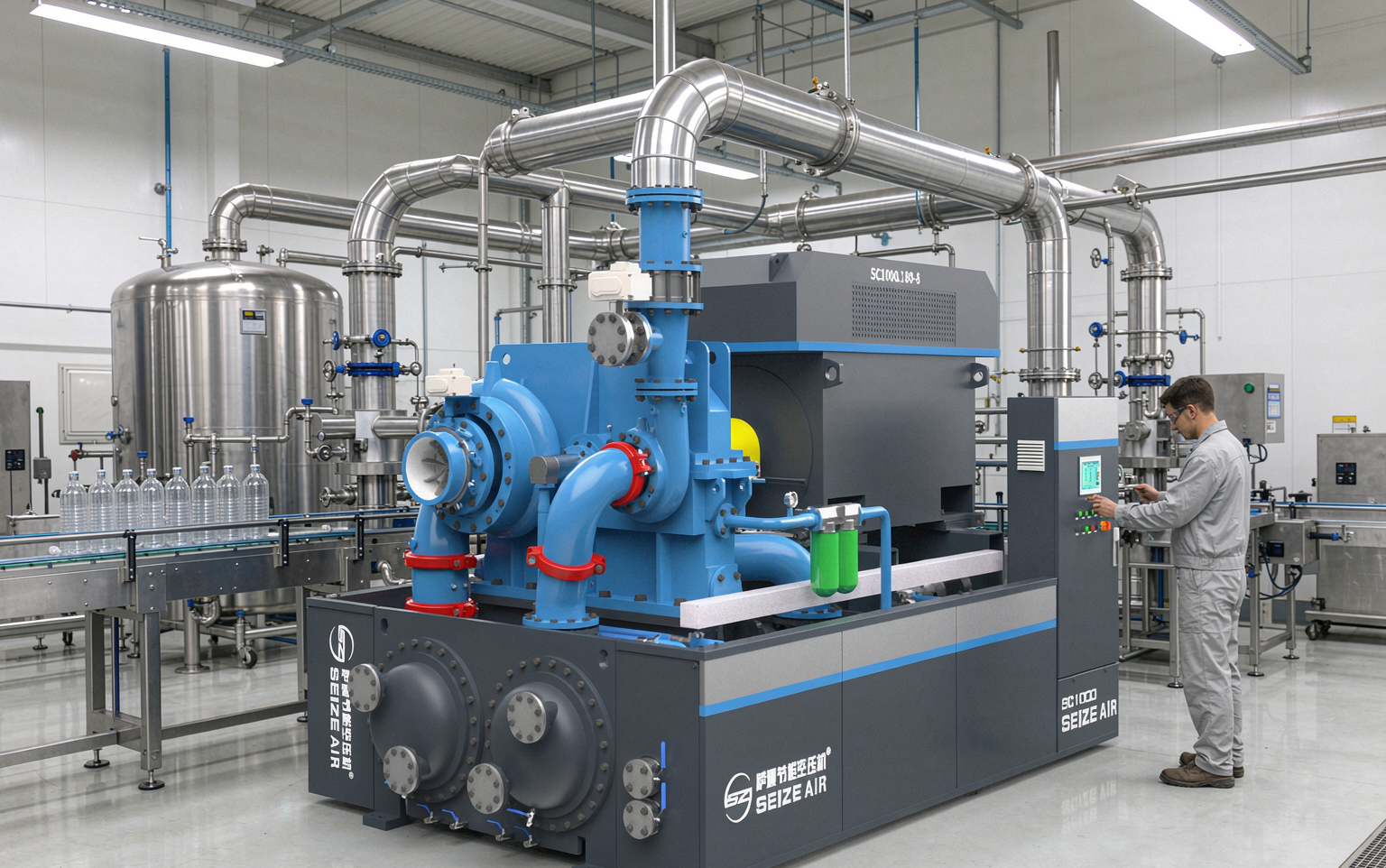
A centrifugal air compressor is engineered for the large, continuous, low-to-medium pressure supply that underpins the whole plant. SEIZE centrifugal units cover 255–2200 kW of power, 1.5–16 bar of pressure, and 80–380 m³/min of flow. That range is ideal for the base-load plant air and for feeding a booster that lifts a portion of the flow up to blow pressure.
The practical architecture on a modern PET line is therefore layered: centrifugal machines generate the bulk of the plant’s stable air at their most efficient operating point, while dedicated high-pressure boosters (or reciprocating boosters) take a sidestream up to ~30–40 bar for the blowing station. This split lets each technology do what it does best.
Air Demand Profile: Intermittent High-Pressure Peaks
The defining feature of PET blowing is not the average demand — it is the shape of the demand curve. Blow air is consumed in pulses. Each molding cavity triggers a high-flow, short-duration air draw, and across a multi-cavity, high-speed rotary blow molder these pulses stack into a demand waveform that looks nothing like a steady industrial load.
Two consequences follow:
- The air receiver is doing real work. A correctly sized receiver absorbs the pulse so the compressor sees a smoother average rather than chasing every spike. Undersize the receiver and the centrifugal machine will see rapid load swings that push it toward its control limits.
- Base-load versus peak-load must be separated. The average volumetric demand over a shift is the number you size the centrifugal foundation on. The instantaneous peak is what you size the receiver, booster, and valving on. Mixing the two up is the most common cause of both oversizing (wasted capital) and undersizing (bottle defects and downtime).
SEIZE centrifugal compressors use PM permanent-magnet VSD (variable speed drive) control, available in single-stage and two-stage configurations, to track base-load changes smoothly. For a PET plant, the value of VSD is less about chasing the blow pulses (the receiver handles those) and more about following the slower day-to-night and line-by-line changes in total plant air demand without throttling losses.
Why Centrifugal Fits High-Volume PET Lines
Centrifugal compressors earn their place when the demand is large, continuous, and stable enough to keep the machine near its design point. That description fits the base-load air of a high-volume PET bottling operation.
A centrifugal air compressor brings three advantages that matter directly to bottlers:
- Oil-free by design. Centrifugal compression has no inter-stage lubrication of the air path in the compression chamber in the way a lubricated screw does. For a plant where a share of the air contacts preforms, this is a structural advantage, not an add-on filter.
- Low maintenance, few wearing parts. With no reciprocating valves, pistons, or rings to wear, scheduled maintenance is dominated by bearings, seals, and controls rather than mechanical rebuilds. For a line that runs around the clock, fewer wear parts means fewer planned stoppages.
- Efficiency at design point. Centrifugal machines are at their best when loaded near their rated flow. SEIZE centrifugal units are offered with IE4 motors as standard, with IE5 optional, and are built and tested to ISO 1217 (plain text) reference conditions. At the right duty, that combination delivers a low specific power that screw and reciprocating machines struggle to match at the same scale.
The catch — and it is an important one — is that centrifugal efficiency collapses if the machine is forced to run far below its design flow. Below roughly 60–70% of design capacity, surge becomes a real risk, and anti-surge control will either recycle air (wasting energy) or the unit must be taken off-line. This is why centrifugal is recommended for high-volume lines with a genuine, stable base-load, not for small or highly intermittent operations.
Oil-Free Requirements in PET
The question “is oil-free air required for PET?” comes up on nearly every bottling project. The honest answer is that it depends on the line and the brand’s quality standard — but the trend is firmly toward oil-free, because the blow air contacts the interior surface of the preform.
Most specification-driven producers reference ISO 8573-1 (plain text) and many call for Class 0, the strictest oil-free grade, for the blow air that touches the bottle. Even where a brand accepts a lower class for plant air, the air that ends up inside the bottle is usually held to the highest standard to avoid taste, odor, or contamination risk.
This is where SEIZE’s oil-free portfolio aligns naturally with PET. Beyond the oil-free air compressor range, the centrifugal machine is oil-free in its compression path by design. For plants that need additional or dedicated oil-free capacity, SEIZE also offers dry oil-free screw compressors rated 37–450 kW at 4.5–10.5 bar, and oil-free scroll compressors at 8–30 kW, 0.8–3.2 m³/min, 8–10 bar. SEIZE also offers what is described as the world’s first 3-stage oil-free screw, extending oil-free capability into higher-pressure, higher-efficiency packages.
For food- and pharma-adjacent purity discussion, SEIZE covers oil-free air for food and pharma, which is useful context when a PET line shares a site with sensitive filling or packaging processes. Note that meeting a specific ISO 8573-1 (plain text) class is a verification step, not an assumption — confirm the achieved grade with SEIZE for your exact configuration.
Energy Efficiency and Heat Recovery
Air compression is one of the largest electrical loads in a bottling plant, so efficiency is where the money is. Three levers apply to a centrifugal-based PET air system:
1. Run the centrifugal at its design point. Specific power (kW per m³/min) is lowest near rated flow. Sizing the machine to the true base-load — not oversizing “for safety” — keeps it in its efficient band. SEIZE centrifugal units, with IE4 (IE5 optional) motors and PM VSD control, are built to hold good efficiency across the normal load range.
2. Separate base-load and peak-load machines. Let the centrifugal carry the steady foundation and let boosters or smaller trim machines handle the blow-pressure peaks. A single oversized machine trying to do everything will spend time throttled or recycled — the most expensive way to make air.
3. Recover the heat. Centrifugal compression rejects a large amount of heat, most of it in the cooling medium. On a PET site, that recovered heat can preheat boiler feedwater, space-heat the warehouse in winter, or support other process loads. The economic case is strongest on continuous,高-output lines where the heat is available every hour of every shift.
What we cannot state without your duty data: the specific specific-power of a centrifugal package at your exact pressure and flow, and the percentage energy saving versus your current setup. Those numbers depend on your existing machines, ambient conditions, and load profile. Use [PLACEHOLDER: SEIZE duty specific-power] and [PLACEHOLDER: SEIZE energy savings %] from a SEIZE audit rather than a generic claim — and insist that any supplier quote these against ISO 1217 (plain text) conditions so the comparison is fair.
Sizing and Redundancy for Continuous Lines
A PET bottling line is rarely allowed to stop for the compressor. When the air system goes down, the filler, blow molder, and packaging line all stop with it — and the cost of a stopped line is usually far higher than the compressor itself. Sizing and redundancy therefore deserve explicit attention.
Size to base-load, with margin for growth — not to peak. As covered, the centrifugal foundation should match the steady average demand, with the receiver and boosters absorbing the blow pulses. SEIZE centrifugal units span 80–380 m³/min, so a single machine or a parallel pair can cover a wide range of plant base-loads; larger sites run multiple units in trim.
Plan N+1 for critical lines. For a continuous operation, a common approach is N+1: enough compressors to carry full demand plus one spare, so maintenance or a fault never stops the line. With VSD control across the fleet, the remaining machines can often absorb a lost unit’s load by drifting up the curve.
Maintain on a schedule, not on failure. Centrifugal machines have few wearing parts, but that makes a disciplined maintenance plan even more valuable — neglected bearings and seals fail suddenly. For sites running lubricated or screw trim machines alongside, a screw compressor maintenance guide helps standardize the program. SEIZE backs its equipment with a global service network, which matters when a spare bearing or a service engineer must reach a remote bottling site quickly.
MTBF (mean time between failures) for a given SEIZE configuration should be confirmed from SEIZE’s reliability data; we do not quote a generic figure here ([PLACEHOLDER: SEIZE MTBF for centrifugal PET duty]).
Centrifugal vs Reciprocating vs Screw for PET
Choosing the right technology starts with the shape and size of your demand. Here is the practical comparison for PET bottle blowing.
| Technology | Best PET role | Oil-free? | Notes for bottlers |
| Centrifugal | Large, stable base-load plant air; feed for boosters | Oil-free by design in compression path | Efficient at design point, low maintenance, but surge risk below ~60–70% flow. SEIZE range: 255–2200 kW, 1.5–16 bar, 80–380 m³/min. |
| Reciprocating | High-pressure boost to ~30–40 bar; small/intermittent lines | Depends on design (oil-free variants exist) | Excellent for high-pressure, lower-flow blow air; more wear parts and higher maintenance at scale. |
| Screw | Mid-range plant air; trim and backup | Lubricated or oil-free (SEIZE dry oil-free screw 37–450 kW, 4.5–10.5 bar) | Flexible and responsive; less efficient than centrifugal at very large stable loads. See screw air compressor. |
The most useful centrifugal vs screw comparison for a PET buyer is not “which is better” but “which does which job.” On a high-volume line the answer is usually a hybrid: centrifugal for the foundation, reciprocating or booster for the blow-pressure peak, and possibly a screw as trim or backup. Small, intermittent, or multi-product lines with widely varying demand may find screw or reciprocating simpler and cheaper to right-size.
How to Select (checklist)
Use this checklist before you engage a supplier. It keeps the conversation on your real duty rather than a catalogue number.
- Map your two air services. Separate low-pressure plant air (~6–10 bar, est.) from high-pressure blow air (~30–40 bar, est.). They are different problems.
- Calculate true base-load. Use shift average flow, not peak, for the centrifugal foundation. Confirm the flow in m³/min and the pressure in bar.
- Define the blow-pressure path. Decide how you reach ~30–40 bar: a booster on the centrifugal sidestream, dedicated reciprocating boosters, or a combined package. Remember SEIZE centrifugal tops out at 16 bar, so a booster is normally required for blow pressure.
- Set your purity class. Specify ISO 8573-1 (plain text) Class 0 if the blow air contacts preforms; confirm the achieved grade with SEIZE.
- Confirm energy metrics. Ask for specific power at your duty and an energy saving estimate against your current machines, both referenced to ISO 1217 (plain text). Use [PLACEHOLDER: SEIZE duty specific-power] and [PLACEHOLDER: SEIZE energy savings %] from the audit.
- Plan redundancy. Decide N+1 and maintenance access. Verify SEIZE’s global service network covers your site and spares lead time.
- Account for heat recovery. Identify a year-round heat sink (boiler feed, space heat, process) to monetize rejected heat.
- Right-size to avoid surge. Keep the centrifugal above ~60–70% of design flow in normal operation; size boosters/trim for the peaks.
- Consider site-specific compressor types if relevant. For remote or off-grid bottling sites, portable options such as a diesel portable air compressor or diesel portable compressors may support commissioning or backup. For mining-adjacent or remote utility supply, see mining diesel compressors and air compressors for DTH drilling as context for rugged mobile air.
FAQ
Q: What pressure air does PET bottle blowing need? A: Two stages — low-pressure for conveying and auxiliary (~6–10 bar, est.) and high-pressure for blow molding (~30–40 bar, est.). The centrifugal supplies the stable base-load; boosters reach blow pressure. [PLACEHOLDER: SEIZE PET pressure×output]
Q: Is oil-free air required for PET? A: Blow air contacts the preform interior; many lines specify ISO 8573-1 Class 0 (plain text) for purity. A centrifugal machine is oil-free by design in its compression path; verify the achieved grade with SEIZE for your configuration.
Q: Why choose centrifugal over reciprocating for PET? A: High, stable, continuous demand favors centrifugal (oil-free by design, low maintenance, efficient at the design point); reciprocating is better for small or intermittent, high-pressure duty. Surge risk below roughly 60–70% of design flow means you must size the centrifugal carefully to the real base-load.
Conclusion
For high-volume PET bottle blowing, the air system is too important to leave to guesswork. A centrifugal air compressor gives you a large, stable, oil-free-by-design foundation at low specific power, while boosters handle the ~30–40 bar blow peaks. The result is lower lifecycle cost, fewer wear-part stoppages, and a cleaner air path into the bottle — provided you size to base-load, plan redundancy, and verify your purity class.
SEIZE AIR’s centrifugal range (255–2200 kW, 1.5–16 bar, 80–380 m³/min, PM VSD single/two-stage, IE4 with IE5 optional, built to ISO 1217 reference conditions) is backed by a global service network and complemented by dry oil-free screw, oil-free scroll, and the world’s first 3-stage oil-free screw for sites that need dedicated oil-free capacity.
Explore more compressor guides for deeper comparisons, or request a quote to have SEIZE size a centrifugal-plus-booster package against your line’s real duty.