
Choosing the wrong main compression technology is one of the most expensive mistakes a plant manager can make. It is not a mistake that shows up on the day of commissioning — it shows up three years later, when your demand profile has shifted, your energy bills have climbed, and the air system you locked in cannot follow the load without burning money. Because a compressor is a 10-to-15-year asset, the early decision between a centrifugal and a rotary screw machine creates a long runway of either flexibility or lock-in. The good news: the choice is not mysterious. It comes down to two variables you already know — your total flow and how much that flow swings hour to hour. This article gives you a practical framework to decide, built around flow rate and demand stability, so you can match the technology to the job instead of inheriting a mismatch.
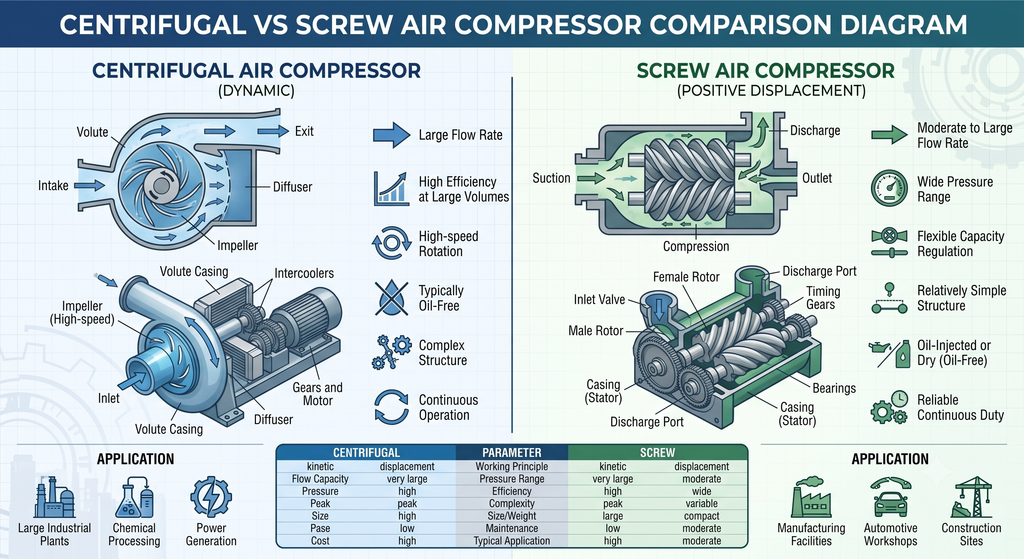
A note on how to read this article: we deliberately avoid a single “winner” because the data does not support one. Instead, think of centrifugal and screw as two tools occupying overlapping but distinct regions of an industrial airflow map. Your job is to locate your plant on that map — by flow, by pressure, by how violently demand swings, and by how clean the air must be — and then pick the tool that sits in your region. The decision matrix near the end compresses the whole argument into one table you can screenshot and take to your procurement meeting. Everything before it explains why the matrix says what it says, so that when someone challenges the recommendation you can defend it with physics rather than opinion.
Key Takeaways
- There is no universal “better” machine. The right answer depends on flow volume and how stable that flow is.
- Centrifugal compressors dominate large, steady base-load demand — SEIZE centrifugal units span 255–2200 kW, 1.5–16 bar, and 80–380 m³/min.
- Rotary screw compressors win on flexibility: they handle mid and small flows, swing loads, and staged capacity expansion far more gracefully.
- Energy efficiency is context-dependent. Centrifugal machines are extremely efficient near their design point; screw machines with permanent-magnet VSD drives hold efficiency across a wide part-load range.
- Centrifugal machines are inherently oil-free in the compression path. SEIZE also offers dry oil-free screw units (37–450 kW, 4.5–10.5 bar) and oil-free scroll that reach ISO 8573-1 Class 0.
- Use the decision matrix at the end to shortlist, then confirm specific power with an ISO 1217 test estimate from SEIZE before you commit capital.
How Centrifugal and Screw Compressors Work
Both technologies move air to higher pressure, but they do it with fundamentally different physics — and those physics are exactly what drive the trade-offs later in this article.
A centrifugal air compressor accelerates air through a high-speed impeller, then converts that kinetic energy into pressure in a diffuser. There are no contacting mechanical parts in the air path, which is why centrifugal designs are inherently oil-free at the compression stage. They are designed to run at a stable operating point, spinning at very high speed and delivering large volumes of air efficiently when loaded near their design flow. SEIZE centrifugal compressors cover 255–2200 kW, pressures from 1.5 to 16 bar, and flows from 80 to 380 m³/min. Learn more about the underlying technology in our guide to the centrifugal air compressor.
A rotary screw compressor traps air between two meshing rotors (a male and a female helix) in a progressively narrowing chamber. It is a positive-displacement machine, which means it delivers a roughly fixed volume per revolution regardless of downstream conditions — making it inherently responsive to load changes. SEIZE screw platforms include PM permanent-magnet VSD single- and two-stage series, with pressure and flow ranges engineered for broad part-load coverage, paired with IE4 motors (IE5 optional) for high electrical efficiency. Explore the screw air compressor line for the full range and selection detail.
The practical consequence: a centrifugal machine behaves like a steady, high-volume turbine that wants to run at one sweet spot, while a screw machine behaves like a responsive, adjustable workhorse that follows the load.
Capacity and Flow Rate: Where Each Wins
Flow is the single most useful first filter. As a rule of thumb, centrifugal compressors become the economically dominant choice above roughly 2,000 CFM of continuous demand (an estimated threshold — confirm against your specific duty). Below that, screw compressors are usually the more sensible and flexible choice.
SEIZE centrifugal compressors reach up to 380 m³/min, which converts to well above 2,000 CFM at the top of the range. They are built for the upper band of industrial demand: central utility plants, large process facilities, and operations where a single large machine or a small cluster of large machines can serve a stable base load. At those volumes, the centrifugal’s low specific power and oil-free compression path make it hard to beat.
Screw compressors, by contrast, cover the mid and small flow territory with far more agility. Because they are positive-displacement and easily paired with VSD control, you can stage multiple smaller screw units, add capacity in steps as the plant grows, and avoid the “one giant machine” risk of over- or under-sizing. If your total flow is below the estimated centrifugal threshold, or if you expect it to grow in uncertain increments, screw is the lower-risk architecture.
A useful mental model: centrifugal is the right answer for “one big, steady thing”; screw is the right answer for “many sizes, changing over time.” Neither is inferior — they simply occupy different regions of the flow map.
Energy Efficiency and Part-Load Behavior
This is where the two technologies diverge most sharply, and where a bad assumption quietly costs the most money.
A centrifugal compressor is extraordinarily efficient when it runs near its design flow and pressure. At that operating point, its specific power is excellent, and large continuous loads are served at minimum energy per unit of air. The catch is the surge line: below roughly 60–70% of design flow, a centrifugal compressor enters an unstable region where it can surge, and its efficiency collapses. In practice this means a centrifugal machine wants to be loaded and kept loaded — it is a full-load champion, not a part-load dancer.
A rotary screw compressor with a PM permanent-magnet VSD drive tells the opposite story. Because the variable-speed motor throttles the rotor speed to match demand, the screw holds respectable efficiency across a wide part-load band. VSD screw units ramp down smoothly when demand falls and ramp up when it rises, avoiding the on/off or load/unload losses that plague fixed-speed machines on swing loads. SEIZE VSD screw series use IE4 (IE5 optional) motors, which raises electrical efficiency at the motor itself on top of the speed-matching benefit.
So the honest answer to “which is more energy efficient” is: it depends on your load shape. Long, full-load, stable demand favors centrifugal. Swing load with frequent partial-load hours favors VSD screw. To make a defensible comparison, request a quote from SEIZE with an ISO 1217 specific-power estimate for your actual duty — the standard defines the efficiency test method, and the measured specific power is what you will actually pay for. Note that real-world efficiency also depends on ancillaries: cooling water or air, inlet air treatment, and pressure dew point all shift the net energy per unit of delivered air. A fair comparison always uses the same system boundary on both sides, otherwise you compare a bare centrifugal frame against a packaged screw skid and draw the wrong conclusion.
[PLACEHOLDER: SEIZE duty specific-power] — specific-power numbers for your exact duty cycle should be inserted here from the SEIZE ISO 1217 test estimate. [PLACEHOLDER: SEIZE energy savings %] — measured part-load energy savings versus fixed-speed baseline for the recommended configuration.
Maintenance, Wear, and Service Intervals
Maintenance philosophy differs because the machines wear differently.
Centrifugal compressors have very few wearing parts in the air path — no rotor contact, no sliding vanes, no valves in the traditional sense. The main items are the high-speed bearings (often oil or magnetic), the gearbox (if present), and the inlet guide vanes. For a plant already running a stable large base load, this translates to long service intervals and low routine wear. The trade-off is that when a major rotating element does need attention, the intervention is specialized.
Rotary screw compressors have meshing rotors and, in oil-lubricated designs, an airend that depends on a healthy oil film. They need regular oil and separator changes, airend inspection, and drive-belt or coupling checks. They are, however, extremely well-understood and serviceable, with a deep global parts base. SEIZE supports both technologies through a global service network, so scheduled maintenance and emergency response are available across regions. For detailed screw upkeep, see our screw compressor maintenance guide.
[PLACEHOLDER: SEIZE MTBF] — mean time between failures figures for the relevant centrifugal and screw series should be inserted from the SEIZE reliability database once validated.
The decision rule: if you want minimal wear-path intervention and can live with specialized major service, centrifugal is attractive at large scale. If you want ubiquitous, predictable, in-house-style servicing, screw is the friendlier platform.
Footprint, Installation, and Capital Cost
Capital cost and floor space tell another part of the story.
Centrifugal compressors are typically large, heavy, and vibration-sensitive. They want a prepared foundation, careful alignment, and sometimes a gearbox and intercooling infrastructure. Their footprint per unit of delivered air is favorable at the very top of the flow range, but the installed cost — including civil works and auxiliary systems — is substantial. They reward you only when the volume justifies the infrastructure.
Screw compressors are compact, skid-mounted, and quick to install. A VSD screw unit can often be dropped in, connected, and running in a fraction of the time and civil cost of a centrifugal installation. This makes screw the default for facilities that value speed-to-air, modular expansion, or limited mechanical room space.
On capital intensity: centrifugal wins the cost-per-CFM race only at high, sustained volume. For most mid-size plants, screw delivers faster payback on installation alone, even before you account for load-following savings.
There is also a staging advantage worth naming explicitly. A screw-based plant can be commissioned with one or two units and expanded in small increments as production ramps — each new unit is a standard skid, a known quantity, and a modest capital event. A centrifugal plant is usually specified up front for a design flow that may not arrive for years, which means you either over-invest early or risk saturation later. If your forecast has any uncertainty — and most do — screw’s modularity is a form of insurance that does not show up in a simple first-cost comparison but absolutely shows up in your five-year capital plan. The trade-off, of course, is that many small screw skids eventually cost more per CFM than one large centrifugal, so the crossover point is precisely the flow threshold discussed earlier.
Oil-Free Options and Air Purity
Air purity is non-negotiable in food, pharmaceutical, electronics, and many process applications — and here the two technologies offer different routes to clean air.
Centrifugal compressors are inherently oil-free in the compression path because there is no oil-flooded rotor. That makes them a natural fit for high-volume Class 0-adjacent demand where you want oil-free air without an oil-free screw airend.
SEIZE also provides dedicated oil-free screw solutions. The dry oil-free screw range covers 37–450 kW and 4.5–10.5 bar, and includes the world’s first 3-stage oil-free screw design. Together with SEIZE oil-free scroll compressors, these reach ISO 8573-1 Class 0 — the strictest oil-free air class. By comparison, a standard oil-lubricated screw plus downstream filtration can reach Class 1 at best and cannot legitimately claim Class 0. For a broader view of the oil-free portfolio, read our guide to the oil-free air compressor, and for sector specifics see oil-free air for food and pharma.
The rule: if you need certified Class 0 and large volume, centrifugal or dry oil-free screw are your routes. If you only need Class 1, a filtered oil-lubricated screw may be acceptable and lower cost — but never label it Class 0.
Decision Matrix: Which to Choose by Application
Use this matrix as a first-pass filter. Match your row to the recommended technology, then validate with an ISO 1217 specific-power estimate.
| Application profile | Flow | Pressure | Demand swing | Purity need | Recommended tech | Why |
| Central utility plant, stable base load | >~2,000 CFM | 1.5–16 bar | Low | Oil-free preferred | Centrifugal | Best specific power at design point; inherently oil-free path |
| Large process, continuous | >~2,000 CFM | mid-high | Low | Class 0 or 1 | Centrifugal or dry oil-free screw | Volume + purity; confirm part-load shape |
| Mid-size plant, growing | <~2,000 CFM | broad | Medium–High | Class 1 typical | VSD screw | Modular expansion, load following |
| Swing load / variable shifts | any | broad | High | Class 1 typical | VSD screw | Holds efficiency across part-load band |
| Food / pharma | any | up to 10.5 bar (screw) | any | Class 0 required | Dry oil-free screw or centrifugal | ISO 8573-1 Class 0 only via oil-free path |
| Mobile / off-grid / mining | any | high | High | Class 1 typical | Diesel portable | See diesel portable air compressor and diesel portable compressors for mining |
| DTH drilling | high | high | High | Class 1 | Diesel portable / screw | See air compressors for DTH drilling and diesel portable compressors in mining |
For mobile, off-grid, and mining scenarios the right comparison is often not centrifugal vs fixed screw at all, but rather a diesel portable package — the table above links the relevant guides for those duty cycles. If your plant is a fixed installation, stay focused on the centrifal vs screw comparison; if it moves, the portable options are the better frame.
FAQ
Q: Which is better, centrifugal or screw air compressor? A: Neither is absolutely better — it depends on flow and demand stability. Centrifugal wins above roughly 2,000 CFM of continuous, stable base-load demand (an estimated threshold — verify against your duty). Screw compressors are more flexible for swing loads, mid and small flows, and situations where capital risk or staged growth matters. Use the decision matrix above to shortlist, then confirm with a SEIZE ISO 1217 specific-power estimate.
Q: Is a centrifugal compressor more energy efficient than screw? A: Usually yes at near design flow with long full-load hours, because the centrifugal’s specific power is excellent at its operating point. But below roughly 60–70% of design flow it approaches surge and efficiency drops sharply. For swing loads, a VSD screw typically beats centrifugal on partial-load efficiency. Confirm with the SEIZE ISO 1217 specific-power estimate for your duty. [PLACEHOLDER: SEIZE duty specific-power]
Q: Can screw compressors be oil-free? A: Yes. SEIZE dry oil-free screw units (37–450 kW, 4.5–10.5 bar, including the world’s first 3-stage oil-free screw) and oil-free scroll compressors reach ISO 8573-1 Class 0. A standard oil-lubricated screw with downstream filtration reaches only Class 1 and cannot legitimately claim Class 0. For high-volume oil-free demand, centrifugal is also inherently oil-free in the compression path.
Conclusion + CTA
The centrifugal vs screw air compressor decision is not about which machine is “best” in the abstract — it is about matching flow, demand stability, purity, and capital strategy to the right architecture. Centrifugal earns its place above roughly 2,000 CFM of steady base load, where its specific power and inherently oil-free path shine. Screw — especially PM VSD screw with IE4/IE5 motors — earns its place everywhere flow is smaller, swing is high, or growth is staged. Use the decision matrix, validate with an ISO 1217 specific-power estimate, and you remove the guesswork that leads to multi-year energy and flexibility lock-in.
Ready to size the right machine for your plant? Request a quote and our application team will model your duty cycle against SEIZE centrifugal and screw platforms. For more comparison and selection guides, browse more compressor guides.